
Vapor Chamber Heatsinks
Capabilities, Benefits, and Applications
What Is a Vapor Chamber?
A vapor chamber is a flat, sealed, two-phase heat spreader—essentially a planar heat pipe. It uses a working fluid (typically water under vacuum) and an internal wick structure to rapidly spread heat laterally across its surface, minimizing hot spots before the heat is dissipated by fins, fans, or liquid cooling.
Capabilities
- Ultra-fast heat spreading
Moves heat evenly from small, concentrated heat sources to a larger area. - High effective thermal conductivity
Often equivalent to thousands of W/m·K, far exceeding solid metals. - Thin, flat form factor
Enables low-profile designs for compact electronics. - Orientation-independent operation
Capillary wick returns condensate regardless of gravity (within design limits). - Hybrid integration
Can be combined with fin stacks, heat pipes, or liquid cold plates. - Material options
Typically copper; aluminum variants available for weight-sensitive designs.
Benefits
- Eliminates hot spots
Dramatically reduces temperature gradients across CPUs, GPUs, and power devices. - Improves overall heatsink efficiency
Ensures downstream fins or cold plates are fully utilized. - Supports higher power densities
Allows more watts in the same footprint. - Enables quieter systems
Better spreading allows lower airflow or smaller fans. - Enhances reliability & lifespan
Lower junction temperatures reduce thermal stress on components.
Applications
High-Performance Computing & Consumer Electronics
- CPUs, GPUs, AI accelerators
- Laptops, tablets, gaming consoles, smartphones
Data Centers
- Server processors and accelerators
- Hybrid air/liquid cooling architectures
Power Electronics
- IGBTs, MOSFET modules
- Power supplies and converters
Telecom & Networking
- Base stations, RF power amplifiers
LED & Optoelectronics
- High-brightness LEDs
- Laser diodes and optical modules
Aerospace, Defense & Industrial
- Rugged electronics with localized heat loads
- Avionics and mission-critical systems
Vapor Chambers vs. Other Thermal Solutions (Quick View)
- vs. Solid copper base: Far superior heat spreading, lighter for the same performance
- vs. Heat pipes: Better 2D heat spreading; ideal for large or multi-chip footprints
- vs. Cold plates: Complementary—vapor chambers spread heat before liquid removal
When to Choose Vapor Chamber Heatsinks
Choose vapor chambers when you need maximum heat spreading, thin profiles, and uniform temperatures—especially for high heat flux, small die sizes, or multi-chip layouts.
If you want, I can compare vapor chambers vs. heat pipes, help size one for your power and footprint, or convert this into website-ready marketing content.
How a Vapor Chamber Heatsink Works
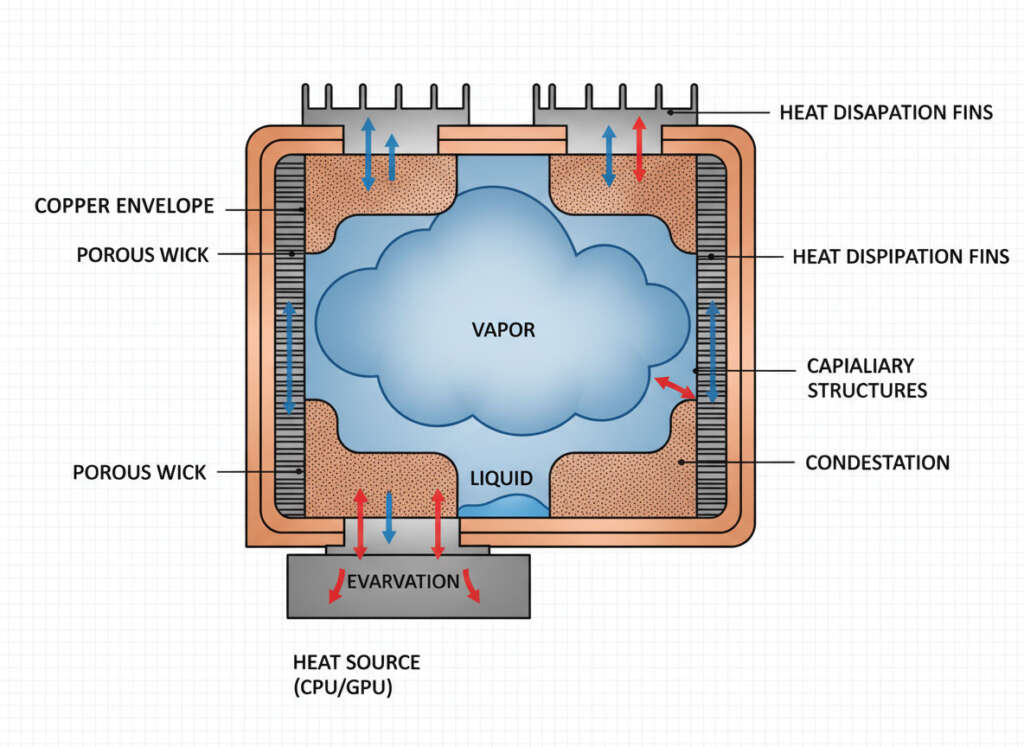
A vapor chamber is a sealed, flat, two-phase heat spreader that moves heat extremely fast by evaporation and condensation, rather than by solid conduction alone.
Main Components
- Sealed enclosure
Usually copper (sometimes aluminum), evacuated and hermetically sealed. - Working fluid
Typically deionized water (chosen for its high latent heat). - Wick structure
Sintered powder, mesh, or grooved channels lining the interior walls. - Heat input & output surfaces
The hot side contacts the heat source; the cool side contacts fins, fans, or a cold plate.
Step-by-Step Operation
1. Heat input (evaporation)
- Heat from a CPU, GPU, or power device enters the vapor chamber base.
- The working fluid at the hot spot absorbs heat and boils, changing from liquid to vapor.
- This phase change absorbs large amounts of energy with only a small temperature rise.
2. Vapor spreading
- The vapor rapidly expands and spreads laterally across the entire chamber.
- Because vapor moves with very low resistance, heat is redistributed almost instantly over a large area.
3. Heat rejection (condensation)
- When vapor reaches cooler regions of the chamber, it condenses back into liquid.
- During condensation, heat is released to:
- attached fin stacks (air cooling),
- heat pipes,
- or liquid cold plates.
4. Liquid return (capillary action)
- The wick structure pulls the condensed liquid back to the hot zone using capillary forces.
- This return works independent of gravity (within design limits), enabling flexible orientations.
5. Continuous cycle
- Evaporation → vapor transport → condensation → liquid return
- This cycle repeats continuously as long as heat is applied.
Why Vapor Chambers Are So Effective
- Phase change heat transfer moves far more energy than solid metal conduction.
- Effective thermal conductivity can reach thousands of W/m·K, far exceeding copper (~400 W/m·K).
- Heat is spread two-dimensionally, unlike heat pipes which move heat mainly in one direction.
Vapor Chamber vs. Solid Base (At a Glance)
| Feature | Solid Copper Base | Vapor Chamber |
| Heat spreading | Limited | Excellent (2D) |
| Hot spot reduction | Moderate | Very high |
| Thickness | Thick for performance | Thin & flat |
| Power density | Limited | High |
When a Vapor Chamber Is Needed
- Small die, high heat flux (CPUs, GPUs, AI chips)
- Uneven or multi-chip heat sources
- Thin, compact designs (laptops, servers, accelerators)
- When downstream fins or cold plates are under-utilized due to hot spots
In simple terms:
A vapor chamber boils liquid at the hot spot, spreads the vapor instantly across the plate, dumps the heat where cooling is available, and wicks the liquid back—over and over again.