

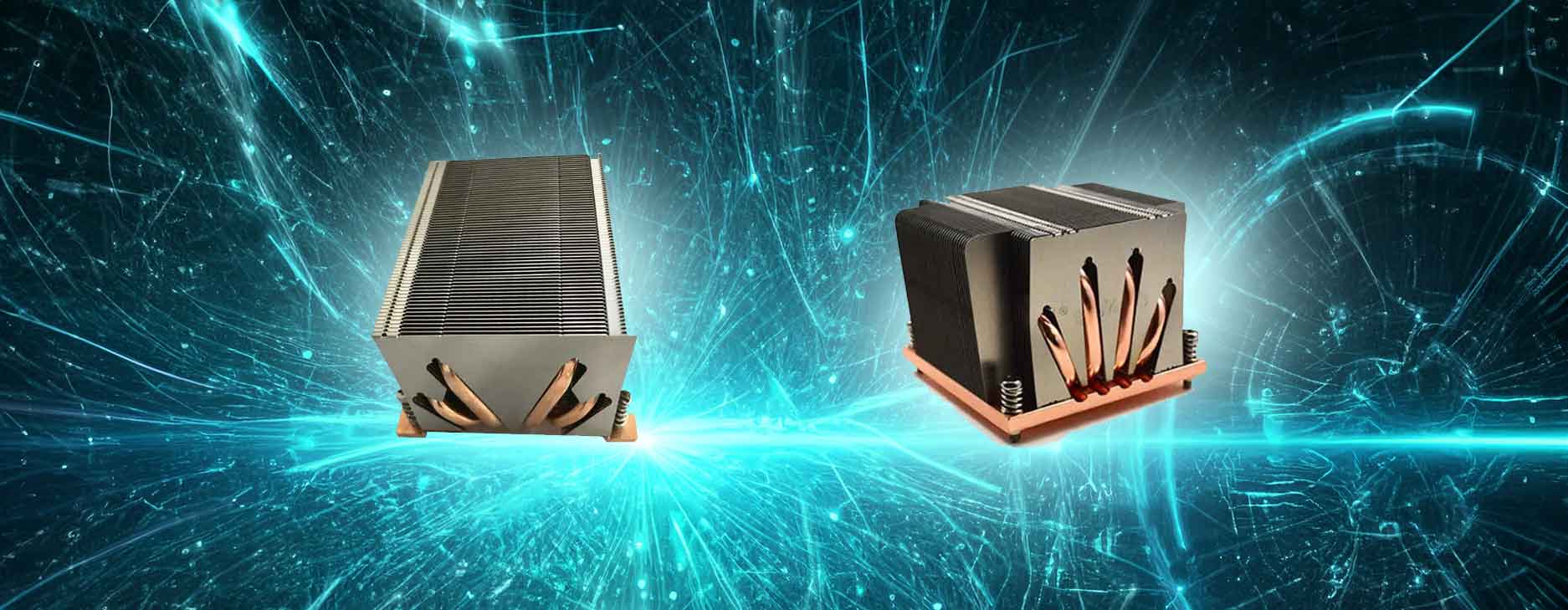
Passive Heatsinks
What They Are, Capabilities, Benefits, and Applications
What Is a Passive Heatsink?
A passive heatsink is a thermal management device that removes heat from electronic components without any moving parts.
It relies entirely on natural convection and radiation to dissipate heat into the surrounding air.
Passive heatsinks are typically made from aluminum or copper and feature fins or extended surfaces that increase surface area for heat transfer.
Capabilities
Passive heatsinks are best suited for low to moderate power dissipation where airflow is limited or undesirable.
Key capabilities include:
- Heat dissipation typically from ~1 W to 50 W (higher with large surface area or chimney effect)
- Operation without power consumption
- Stable, predictable thermal performance
- Scalable size, from small chip-level sinks to large enclosure-mounted designs
- Compatibility with various manufacturing methods (extrusion, forging, die casting, skiving)
Performance depends strongly on:
- Ambient temperature
- Orientation (vertical fins perform better)
- Available free air volume
Benefits
Passive heatsinks offer unique advantages, especially in reliability-critical applications:
- No Moving Parts
Eliminates fan failures, vibrations, and maintenance concerns. - Silent Operation
Ideal for noise-sensitive environments such as medical, consumer, and office electronics. - High Reliability & Long Life
With no mechanical wear, passive heatsinks often outlast the electronics they cool. - Zero Power Consumption
Improves overall system efficiency and simplifies power design. - Harsh Environment Compatibility
Performs well in dusty, humid, or sealed systems where fans would fail.
Applications
Passive heatsinks are widely used where simplicity, reliability, and silence are priorities:
Consumer Electronics
- Set-top boxes and media players
- Home networking devices
- LED lighting fixtures
Industrial Electronics
- PLCs and control modules
- Sensors and instrumentation
- Embedded computers in sealed enclosures
Telecommunications
- Remote radio units
- Outdoor telecom equipment
- Small network devices
Automotive & Transportation
- Infotainment modules
- Control electronics
- Sensors and cameras
Medical & Scientific Equipment
- Monitoring devices
- Portable diagnostic equipment
- Low-noise laboratory instruments
Design Considerations
When selecting or designing a passive heatsink, key factors include:
- Thermal resistance requirement (°C/W)
- Available space and orientation
- Ambient temperature
- Surface finish (black anodizing improves radiation)
- Mounting method (PCB, chassis, or enclosure wall)
Summary
Passive heatsinks provide a simple, silent, and highly reliable cooling solution for low-to-moderate power electronics. While they require more space than active solutions for the same heat load, their durability and zero-maintenance operation make them ideal for long-life and mission-critical applications.
- Compare passive vs. active heatsinks
- Help size a passive heatsink for a specific wattage
- Explain how orientation and fin design affect natural convection performance