

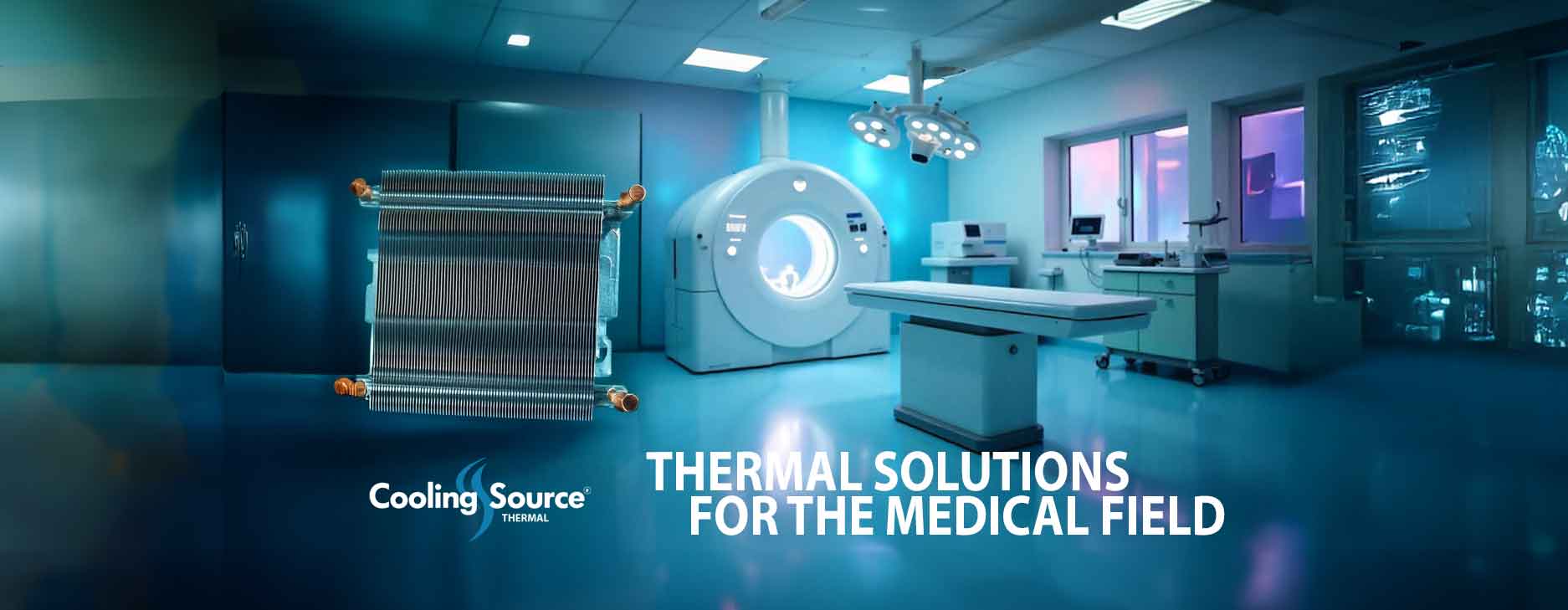
Thermal management in medical devices is critical for patient safety, device reliability, regulatory compliance, and long-term performance. Medical-grade heatsinks must deliver stable, quiet, and contamination-free cooling while meeting strict standards for cleanliness, traceability, and material quality.
Common Heatsink Types Used in Medical Applications
1. Extruded Aluminum Heatsinks
Description:
Manufactured from high-purity aluminum alloys (commonly 6063) with precise fin geometries for consistent passive cooling.
Key Benefits:
- Reliable and repeatable thermal performance
- Cost-effective for production programs
- Easy to anodize for corrosion resistance and cleanability
- Lightweight and electrically non-conductive when coated
Typical Medical Applications:
- Patient monitoring systems
- Diagnostic electronics
- Medical power supplies
- Laboratory instruments
2. Cold Forged Heatsinks
Description:
Formed under high pressure to produce dense material structures with superior thermal conductivity.
Key Benefits:
- Excellent heat dissipation in compact footprints
- High fin density for space-constrained designs
- Low thermal resistance
Typical Medical Applications:
- Portable medical devices
- Imaging sensors
- Compact control modules
- Handheld diagnostic equipment
3. Bonded Fin Heatsinks
Description:
Fins are bonded or brazed to a base to increase surface area beyond extrusion limits.
Key Benefits:
- Higher heat dissipation capability
- Flexible fin spacing and height
- Suitable for medium-to-high power electronics
Typical Medical Applications:
- Medical laser systems
- RF and ultrasound equipment
- Advanced diagnostic platforms
4. Die Cast Aluminum Heatsinks
Description:
High-pressure die casting allows complex shapes with integrated housings, mounts, and airflow channels.
Key Benefits:
- Mechanical and thermal integration in one component
- Robust and vibration-resistant
- Suitable for enclosed systems
Typical Medical Applications:
- Imaging equipment (CT, MRI auxiliary electronics)
- Medical analyzers
- Stationary hospital equipment
5. Heat Pipe & Hybrid Heatsinks
Description:
Heat pipes embedded in aluminum bases rapidly spread heat away from sensitive components.
Key Benefits:
- Excellent heat spreading and temperature uniformity
- Enables sealed or fanless designs
- Supports high heat flux components
Typical Medical Applications:
- Medical imaging subsystems
- Surgical navigation systems
- High-power processors in medical workstations
6. Liquid-Cooled Cold Plates
Description:
Liquid cold plates use circulating fluid to remove heat from high-power electronics.
Key Benefits:
- Very low thermal resistance
- Quiet operation (no airflow noise)
- Ideal for continuous-duty medical systems
Typical Medical Applications:
- Medical lasers
- Radiation therapy equipment
- High-power diagnostic and treatment systems
Medical Applications & Thermal Requirements
| Medical Application | Power Level | Heatsink Solution |
| Patient monitors | Low | Extruded / stamped |
| Portable medical devices | Low–Medium | Cold forged |
| Diagnostic equipment | Medium | Extruded / bonded fin |
| Imaging systems | Medium–High | Die cast / heat pipe |
| Medical lasers | High | Bonded fin / liquid cold plate |
Key Design Considerations for Medical Heatsinks
- Regulatory compliance (FDA, IEC 60601, ISO 13485)
- Cleanability & biocompatible finishes
- Silent operation (passive or low-noise cooling)
- High reliability & long service life
- Traceability & controlled manufacturing processes