

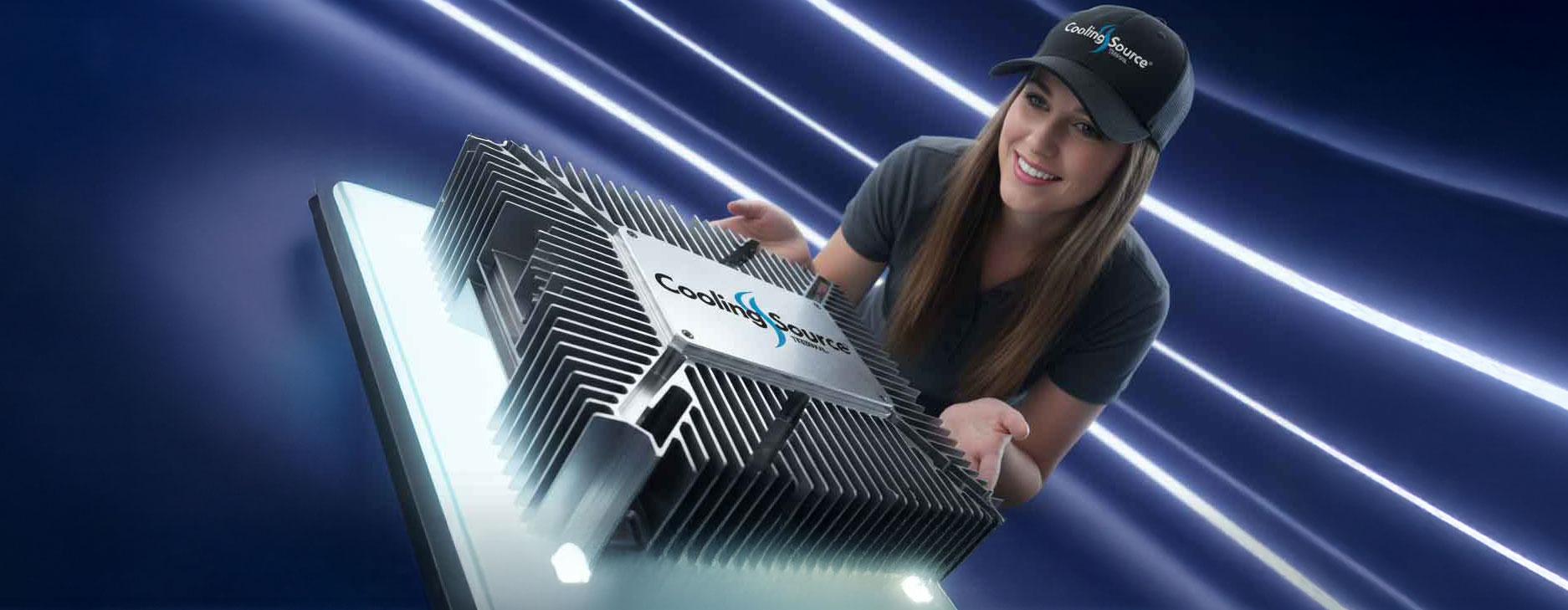
What Is a Custom Heatsink?
A custom heatsink is a thermal management solution engineered specifically for an application’s heat load, mechanical envelope, airflow conditions, environmental exposure, and reliability requirements. Unlike standard catalog parts, custom heatsinks are designed using real operating data to ensure predictable, validated thermal performance in the final system.
At Cooling Source, custom heatsinks are developed through a disciplined engineering process that integrates thermal modeling, mechanical design, material science, and manufacturing expertise—from concept through full production.
Benefits of Custom Heatsinks
Optimized Thermal Performance
Custom heatsinks allow engineers to precisely control:
- Fin geometry, height, pitch, and spacing
- Airflow direction and pressure drop
- Heat spreading and hot-spot mitigation
- Junction-to-ambient thermal resistance (RθJA)
This results in lower component temperatures, improved electrical stability, and extended service life.
Mechanical & System Integration
Custom designs ensure seamless integration into your system:
- Exact footprint and height constraints
- Optimized mass and mechanical rigidity
- Direct mounting to PCBs, cold plates, or enclosures
- Compatibility with screws, push pins, clips, or custom hardware
The outcome is simplified assembly, improved manufacturability, and reduced system-level risk.
Material & Technology Flexibility
Custom heatsinks can incorporate:
- Aluminum extrusions, cold-forged or CNC-machined designs
- Copper or hybrid aluminum/copper constructions
- Embedded heat pipes or vapor chambers
- Surface treatments such as anodizing, nickel plating, or passivation
Each solution is engineered for thermal efficiency, durability, and cost-effective scalability.
Cooling Source Custom Heatsink Design Process
1. Application Review & Thermal Requirements
- Power dissipation and heat flux mapping
- Ambient temperature and airflow conditions
- Environmental and reliability constraints
- Regulatory and compliance requirements
2. Thermal & Mechanical Engineering
- Thermal simulations and analytical modeling
- Fin optimization and material selection
- Structural and mounting analysis
- Design-for-manufacturability (DFM)
3. Prototype & Validation
- Rapid prototyping using production-capable processes
- Dimensional inspection and fit verification
- Thermal performance testing
- Iterative refinement, if required
4. Production & Quality Control
- Controlled manufacturing processes
- Lot traceability and documentation
- Dimensional, mechanical, and visual inspection
- Optional thermal performance validation
This structured approach ensures first-time-right designs and smooth transition from prototype to volume production.
Engineering Advantages
- Application-specific thermal optimization
- Reduced risk of late-stage redesigns
- Improved MTBF and long-term reliability
- Lower total cost of ownership
- Expert thermal guidance throughout the design cycle
Markets & Applications
Cooling Source custom heatsinks are deployed in performance-critical industries including:
- Defense & Aerospace (ITAR-Sensitive Programs)
- Industrial Electronics & Power Conversion
- Telecommunications & Networking Infrastructure
- Medical & Diagnostic Equipment
- Automotive & Transportation Electronics
- Data Processing, Embedded & Edge Computing
Whether the challenge is high power density, sealed enclosures, shock and vibration, or long service life, our custom solutions are engineered to perform reliably in real-world conditions.
ITAR & Defense-Ready Manufacturing
Cooling Source supports defense and aerospace programs with manufacturing processes designed to meet ITAR and controlled-program requirements, including:
- Secure engineering collaboration
- Controlled documentation and traceability
- Consistent, repeatable production quality
- Long-term program support and revision control
This makes Cooling Source a trusted partner for mission-critical thermal solutions.
Types of Custom Heatsinks
Cooling Source designs and manufactures a wide range of custom heatsink architectures, selected based on thermal performance requirements, mechanical constraints, production volume, and cost targets.
Custom Extruded Heatsinks
Extruded heatsinks are ideal for applications requiring cost-effective thermal performance with consistent cross-sectional geometry.
Key characteristics:
- Aluminum extrusions with optimized fin geometry
- Excellent performance in natural or forced convection
- High repeatability and scalability
- Ideal for medium to high production volumes
Typical applications: Industrial electronics, power supplies, telecom infrastructure
CNC Machined Heatsinks
Machined heatsinks provide maximum design freedom for complex geometries and tight tolerances.
Key characteristics:
- Complex 3D shapes and variable fin structures
- Precise mounting features and interfaces
- Suitable for low-to-medium volumes and prototypes
- Excellent for tight mechanical envelopes
Typical applications: Defense electronics, medical devices, embedded computing
Cold Forged Heatsinks
Cold forging produces high-density fin structures for high heat flux applications.
Key characteristics:
- Superior thermal conductivity due to grain flow alignment
- Tall, thin fins with minimal base thickness
- High structural integrity
- Optimized for high-power components
Typical applications: Power electronics, automotive modules, high-power LEDs
Bonded Fin Heatsinks
Bonded fin heatsinks are used when high fin density or extreme aspect ratios are required.
Key characteristics:
- Aluminum or copper fins bonded to a base
- Very high surface area
- Excellent forced-air performance
- Suitable for high power density designs
Typical applications: Data processing, networking equipment, industrial systems
Custom Heat Pipe Heatsinks
Heat pipe heatsinks combine traditional fins with embedded heat pipes to move heat away from localized hot spots.
Key characteristics:
- High effective thermal conductivity
- Efficient heat spreading across the fin field
- Enables cooling of remotely located fin stacks
- Ideal for space-constrained designs
Typical applications: Defense avionics, sealed enclosures, compact electronics
Vapor Chamber Heatsinks
Vapor chambers provide two-dimensional heat spreading for components with high and uneven heat flux.
Key characteristics:
- Extremely low thermal resistance
- Uniform temperature distribution
- Supports multi-chip and high-power devices
- Can be integrated into cold plates or fin stacks
Typical applications: High-performance computing, RF systems, advanced defense electronics
Hybrid & Application-Specific Designs
Many applications require hybrid solutions combining multiple technologies.
Examples include:
- Extruded or forged bases with embedded heat pipes
- Copper bases with aluminum fin stacks
- Integrated cold plates and liquid assist options
- Custom mounting and enclosure-integrated designs
These solutions are engineered to meet unique thermal, mechanical, and environmental challenges.
Engineering-Driven Selection
The optimal custom heatsink type is determined through thermal modeling, mechanical analysis, and manufacturing trade studies to ensure the best balance of:
- Thermal performance
- Mechanical reliability
- Production scalability
- Total cost of ownership
Cooling Source partners with engineers early in the design cycle to select and engineer the most effective solution for each application.
Custom Heatsink Selection Guide
The table below provides a general engineering reference for selecting the appropriate custom heatsink technology based on thermal load, airflow, mechanical complexity, and production volume. Final selection is validated through thermal analysis and application review.
Custom Heatsink Technology Selection Guide
Heatsink Type |
Typical Power Dissipation |
Airflow Condition |
Design Complexity |
Production Volume |
Key Advantages |
Common Applications |
Extruded Aluminum |
Low to Medium (5–75 W) | Natural or Forced | Low | Medium–High | Cost-effective, scalable, robust | Industrial electronics, power supplies |
CNC Machined |
Low to Medium (5–100 W) | Natural or Forced | High | Low–Medium | Maximum design freedom, tight tolerances | Defense, medical, embedded systems |
Cold Forged |
Medium to High (30–200 W) | Forced | Medium | Medium–High | High fin density, excellent conductivity | Power electronics, automotive |
Bonded Fin |
High (75–300+ W) | Forced | Medium | Medium | High surface area, excellent airflow utilization | Networking, data processing |
Heat Pipe Heatsink |
Medium to Very High (50–500+ W) | Natural or Forced | High | Low–Medium | Heat spreading, remote heat transport | Sealed enclosures, avionics |
Vapor Chamber |
High to Extreme (100–1000+ W) | Forced or Liquid Assist | High | Low–Medium | Ultra-low thermal resistance, uniform temperature | HPC, RF, defense electronics |
Hybrid / Integrated |
Application Dependent | Any | Very High | Custom | Optimized system-level solution | Mission-critical systems |
Engineering Notes
- Power ranges are approximate and depend on airflow, ambient temperature, and allowable temperature rise.
- Natural convection designs typically require larger surface area and lower heat flux.
- Forced-air systems benefit from higher fin density and optimized airflow paths.
- Heat pipes and vapor chambers are recommended for high heat flux, hot-spot management, or space-constrained designs.
Cooling Source engineers validate each design through thermal modeling, prototyping, and performance testing to ensure real-world performance matches requirements.
Need Help Selecting the Right Architecture?
Every application is different. Cooling Source partners directly with engineering teams to evaluate:
- Thermal loads and heat flux
- Mechanical constraints
- Environmental and reliability requirements
- Cost and production targets
- ITAR and defense compliance needs
Contact our engineering team to discuss the optimal custom heatsink solution for your application.
From Concept to Production
From early-stage design reviews and thermal analysis to prototyping and high-volume manufacturing, Cooling Source partners directly with engineering teams to solve complex heat dissipation challenges efficiently, reliably, and repeatably.
Contact our engineering team to discuss your custom heatsink requirements.