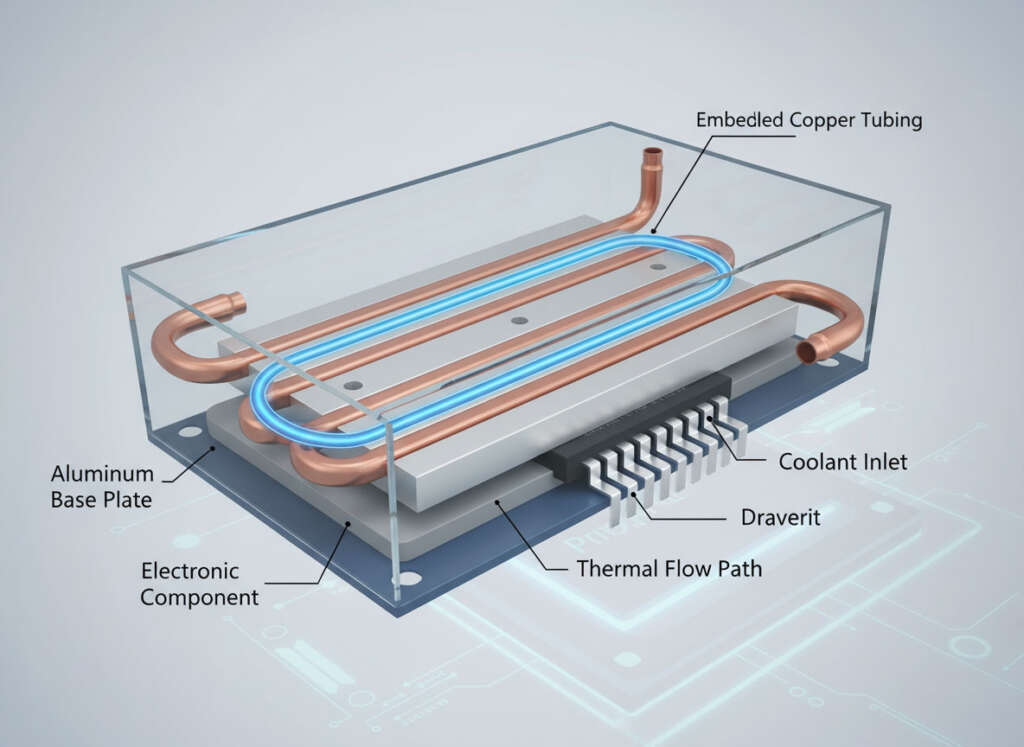


What Is a Liquid Cold Plate?
A liquid cold plate is a high-performance thermal solution that transfers heat from electronic components to a circulating coolant (water, water-glycol, dielectric fluids). By using liquid rather than air, cold plates achieve much higher heat flux removal and stable temperatures in compact spaces.
Types of Liquid Cold Plates
1. Machined Channel Cold Plates
- Construction: CNC-machined channels in aluminum or copper, sealed with a cover plate.
- Strengths: Flexible layouts, good performance, fast prototyping.
- Typical use: Industrial electronics, power supplies, EV modules.
2. Brazed / Vacuum-Brazed Cold Plates
- Construction: Multiple metal layers brazed together to form complex internal passages.
- Strengths: Leak-free, high reliability, thin profiles.
- Typical use: Automotive, aerospace, telecom.
3. Skived Fin Cold Plates
- Construction: Skived copper or aluminum fins inside the flow path.
- Strengths: Extremely high surface area and heat transfer.
- Typical use: High-heat-flux power electronics.
4. Stamped / Formed Cold Plates
- Construction: Stamped channels bonded or brazed to a base plate.
- Strengths: Cost-effective for high volumes.
- Typical use: Automotive and consumer electronics.
5. Friction Stir Welded (FSW) Cold Plates
- Construction: Solid-state welding seals machined channels with no filler material.
- Strengths: Excellent mechanical strength, no porosity, high thermal efficiency.
- Typical use: EV batteries, power inverters, demanding industrial systems.
6. Microchannel Cold Plates
- Construction: Very fine channels for maximum heat transfer.
- Strengths: Exceptional heat flux capability.
- Typical use: CPUs, GPUs, laser diodes, advanced computing.
Capabilities
- High heat flux removal
Effectively cools loads from hundreds to thousands of watts. - Uniform temperature control
Reduces hot spots across large or uneven heat sources. - Compact & lightweight designs
Enables higher power density than air-cooled heatsinks. - Material flexibility
Aluminum for cost and weight, copper for maximum thermal conductivity. - Custom flow paths
Channels optimized for pressure drop, turbulence, and thermal uniformity.
Benefits
- Much higher performance than air cooling
Liquid cooling can be 5–10× more effective than traditional finned heatsinks. - Lower junction temperatures
Improves component efficiency, reliability, and lifespan. - Reduced system noise
Smaller or slower fans compared to air-cooled solutions. - Scalable for future power increases
Supports next-generation electronics without major enclosure changes. - System-level efficiency
Allows heat reuse or centralized thermal management.
Applications
Power Electronics
- IGBTs, MOSFETs, power modules, inverters, converters
Automotive & EV
- Battery thermal management
- Onboard chargers
- Traction inverters and DC-DC converters
Data Centers & High-Performance Computing
- CPUs, GPUs, AI accelerators
- Direct-to-chip and cold-plate-based liquid cooling loops
Telecom & Networking
- Base stations, RF amplifiers, high-power networking equipment
Industrial & Medical Equipment
- Motor drives, lasers, imaging systems, precision instrumentation
Energy & Renewable Systems
- Solar inverters, wind power converters, energy storage systems
When to Choose Liquid Cold Plates
Liquid cold plates are ideal when:
- Heat loads exceed the limits of air cooling
- Space is constrained and power density is high
- Temperature stability and reliability are mission-critical