Heat Pipes
A heat pipe is a passive thermal management device designed to efficiently transfer heat away from high-power or temperature-sensitive components. By leveraging phase-change heat transfer, heat pipes move large amounts of thermal energy with minimal temperature drop, outperforming solid metals while requiring no power or moving parts.
Heat pipes are widely used in electronics, power conversion, aerospace, defense, medical, LED lighting, and industrial systems where reliability, performance, and compact design are critical.
How a Heat Pipe Works
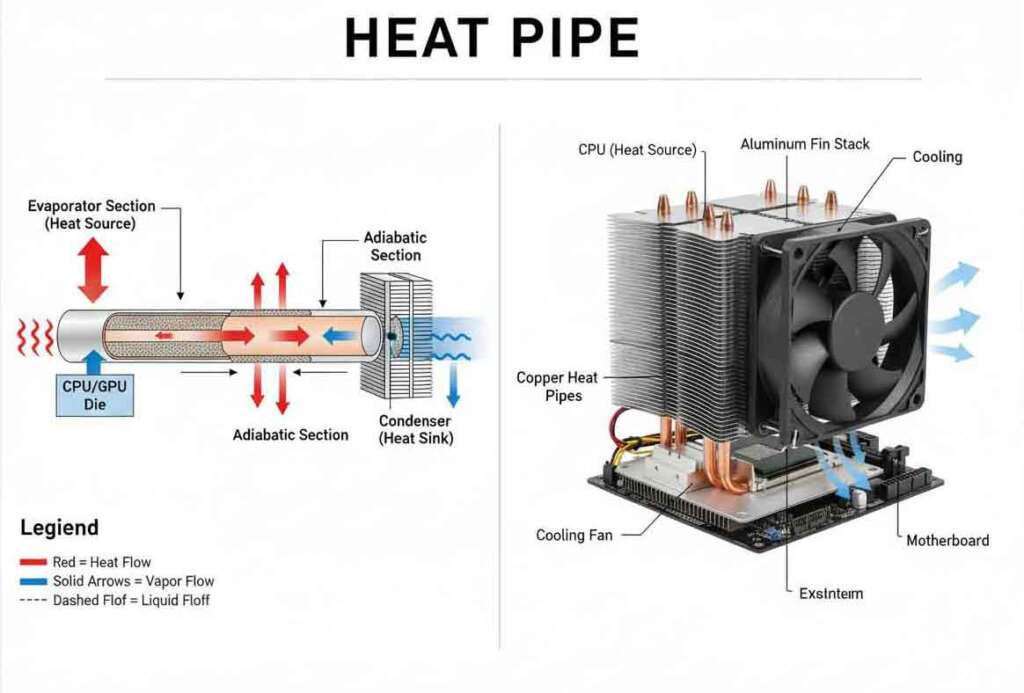
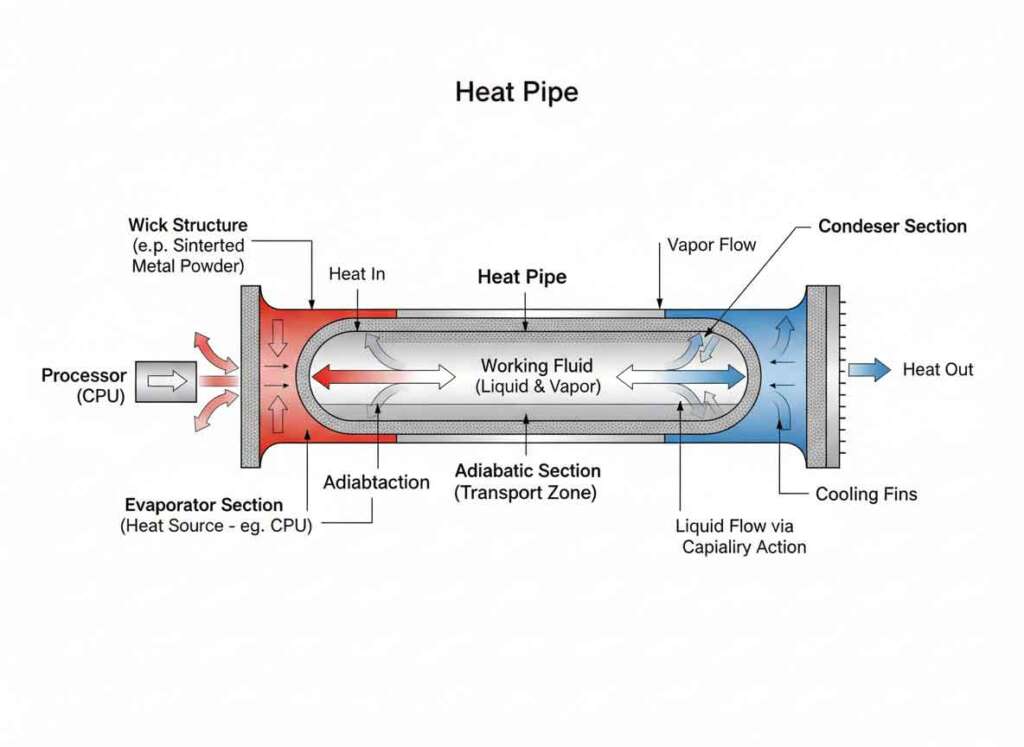
A heat pipe is a sealed metal enclosure containing a small amount of working fluid and an internal capillary wick structure.
- Evaporation (Heat Input Zone)
Heat applied at the evaporator causes the internal fluid to vaporize.
- Vapor Transport
The vapor rapidly travels to the cooler region of the heat pipe.
- Condensation (Heat Rejection Zone)
The vapor releases heat and condenses back into liquid.
- Capillary Return
The wick structure returns the liquid to the heat source via capillary action.
This continuous cycle transfers heat efficiently without pumps, fans, or external power.
Heat Pipe Types
Conventional Heat Pipes
- Cylindrical or flattened tubes
- Copper or aluminum construction
- Suitable for a wide range of electronic and industrial applications
Wick Structure Variations
- Sintered wick – High capillary force, works in any orientation
- Grooved wick – Cost-effective, best for horizontal layouts
- Mesh/screen wick – Flexible design with moderate performance
Vapor Chambers
- Flat, two-dimensional heat pipes
- Excellent for spreading heat from concentrated hot spots
- Common in CPUs, GPUs, and high-power modules
Loop Heat Pipes
- Separate vapor and liquid flow paths
- High heat transport capacity over long distances
- Used in aerospace and telecom systems
Capabilities
- Extremely high effective thermal conductivity (up to 100,000 W/m·K)
- Heat transfer capacity ranging from a few watts to several hundred watts
- Long-distance heat transport with minimal temperature gradient
- Orientation-independent operation with sintered wick designs
- Custom form factors, including bent and ultra-thin profiles
Key Benefits
Passive and Reliable
- No moving parts
- No power consumption
- Long operational life
Superior Thermal Performance
- Efficient heat removal from localized hot spots
- Minimal temperature drop between heat source and sink
Design Flexibility
- Enables compact, lightweight thermal solutions
- Easily integrated into heat sinks, cold plates, and assemblies
Improved System Reliability
- Reduces component temperatures
- Enhances product lifespan and performance stability
Applications
Electronics & Computing
- CPUs, GPUs, and AI accelerators
- Power supplies and telecom hardware
- Data center and networking equipment
Power Electronics
- IGBT modules
- Inverters and converters
- EV power systems
LED & Lighting
- High-power LED modules
- Outdoor and industrial lighting
Aerospace & Defense
- Avionics and radar systems
- Satellite thermal control
- Ruggedized electronics
Medical & Scientific Equipment
- Imaging systems
- Diagnostic and laboratory instruments
- Laser and optical systems
Why Use Heat Pipes Instead of Solid Metal?
Compared to solid copper or aluminum, heat pipes provide significantly higher thermal performance at lower weight while maintaining passive, maintenance-free operation. They are ideal for applications where heat must be moved efficiently from confined spaces to remote heat sinks.


 Cooling Source Is Now Part of Heatscape, Backed by Guardian Capital Partners.

 2021 Las Positas Ct,
 Call us (925) 292.1293