
What is a TEC Heatsink?
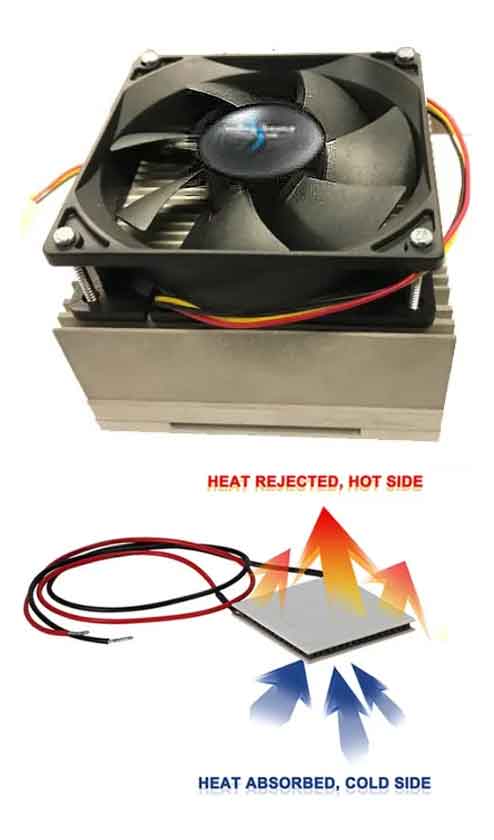
A TEC heatsink is a thermal solution designed to work with a Thermoelectric Cooler (TEC)—also known as a Peltier module. When powered, a TEC pumps heat from its cold side to its hot side. The heatsink (often with a fan, heat pipes, or liquid cooling) is mounted on the hot side to efficiently reject that heat to ambient. Proper heatsink selection is critical; inadequate heat rejection drastically reduces cooling capacity and efficiency.
Capabilities
- Active cooling below ambient: Can achieve temperatures below room temperature (ΔT up to ~60–70 °C under ideal conditions).
- Precise temperature control: Fast response and fine control using closed-loop PID controllers.
- Bidirectional operation: Reversing current allows heating or cooling with the same device.
- Compact form factor: Enables spot cooling in tight spaces where compressors are impractical.
- Scalable designs: From small fin/fan sinks to heat-pipe or liquid-cooled cold plates for higher loads.
Benefits
Performance & Control
- No moving parts in the TEC itself → silent, vibration-free at the module level
- Instantaneous control for stabilization, set-point holding, and rapid cycling
- Ideal for sensitive electronics and optics requiring tight temperature stability
Design & Integration
- Solid-state reliability (long service life when properly derated)
- Works in any orientation
- Clean operation—no refrigerants or compressors
System Flexibility
- Heatsinks can be optimized for air cooling, forced convection, or liquid cooling
- Modular stacking for higher ΔT or capacity (with efficiency trade-offs)
Key Design Considerations (Critical)
- Hot-side heat rejection: The heatsink must dissipate (load heat + TEC electrical power).
- Thermal resistance (θSA): Lower is better; undersizing the heatsink quickly collapses ΔT.
- Condensation management: Sub-ambient operation may require sealing, insulation, or conformal coating.
- Power efficiency: TECs are less efficient than vapor-compression; expect higher power draw.
- Mechanical flatness & TIM: Even pressure and high-quality TIM are essential for performance.
Typical TEC Heatsink Types
- Extruded fin + fan: Compact, cost-effective for low–moderate loads
- Heat-pipe assisted heatsinks: Improved spreading and lower θSA
- Liquid-cooled cold plates: For high heat flux or quiet operation
- Integrated TEC modules: Factory-assembled stacks with matched heatsinks and controls
Applications
- Optoelectronics: Laser diodes, photodetectors, optical sensors
- Medical & life sciences: Diagnostics, lab instruments, sample cooling
- Industrial & metrology: Precision measurement, calibration equipment
- Telecom & RF: Frequency stabilization, low-noise electronics
- Consumer & specialty electronics: CCD/CMOS camera cooling, niche enclosures
- Aerospace & defense: Ruggedized electronics requiring tight thermal control
When to Choose a TEC Heatsink
Choose a TEC-based solution when you need:
- Temperature below ambient or very tight control (±0.1–0.5 °C)
- Compact, solid-state cooling without compressors
- Rapid thermal response and bidirectional heating/cooling
Avoid TECs when:
- Energy efficiency is critical
- Heat loads are very high without space for a large or liquid-cooled heatsink
If you want, Cooling Source can help size a TEC and heatsink for your exact heat load and ambient, compare air vs liquid cooling, or provide design rules (θ targets, insulation, condensation control).