 Cooling Source Is Now Part of Heatscape, Backed by Guardian Capital Partners.
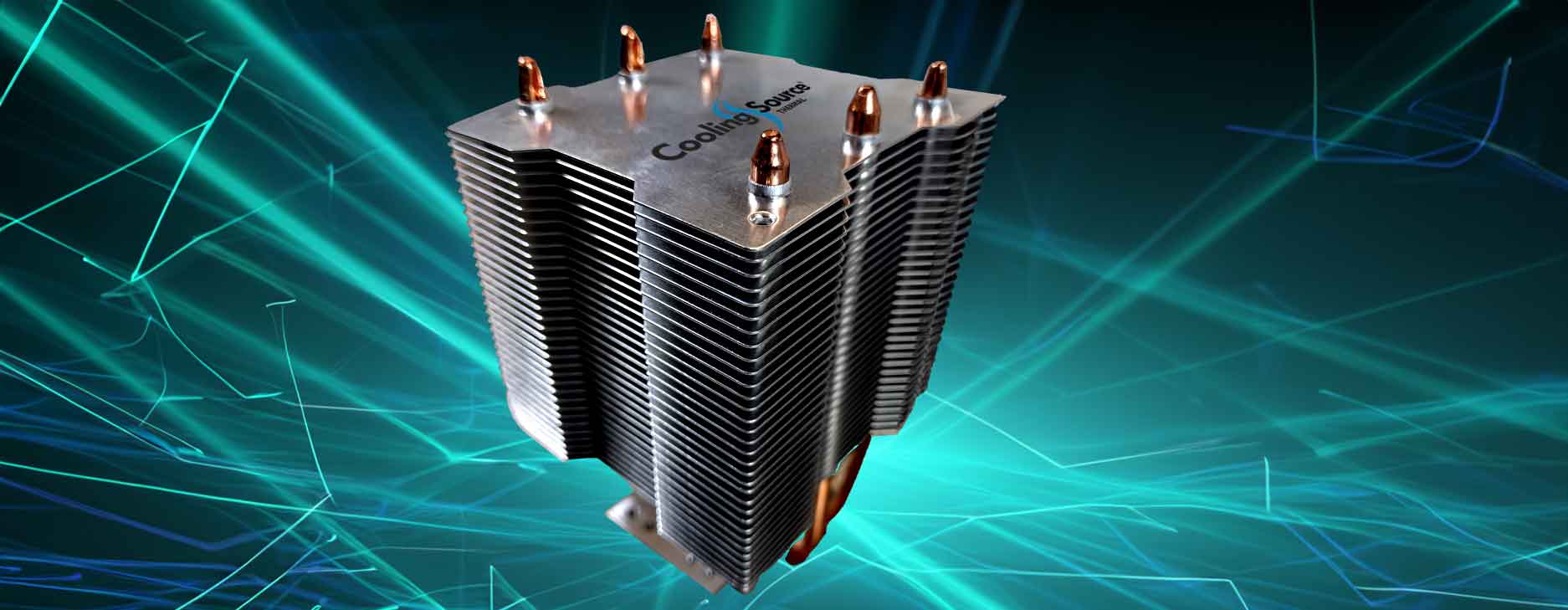
Stamped fin heat sink:
This process manufacture fins by applying extreme pressure to a blank piece of aluminum or copper and forming into the desired height, thickness and shape. The fins are then bonded to the heat sink metal base.
Stamped fins heatsinks are more suited for electronics applications and fan sink applications because they offer an excellent balance of performance, cost, and manufacturability.
1. Cost-Effective Manufacturing
- Stamped fins are produced using metal stamping tools, making them cheaper than machined or bonded fin heatsinks.
- Ideal for medium- to high-volume production where tooling cost is easily amortized.
2. High Surface Area for Improved Cooling
- The stamping process allows thin metal fins, increasing the available heat-dissipation surface area.
- More surface area = better convection performance, especially with forced air (fans).
3. Lightweight Design
- Thin stamped fins reduce overall weight, useful in portable or weight-sensitive designs (telecom, automotive ECUs, LED modules).
4. Good Airflow Characteristics
- Fins can be shaped or louvered to increase turbulence, boosting heat transfer.
- Works especially well in forced-air environments.
5. Compatibility With Various Base Materials
- Aluminum is most common, offering good thermal conductivity and low weight.
- Copper bases can be added for higher thermal spreading.
6. Flexible Geometries
- Stamping allows custom fin shapes, spacing, and height variations.
- Enables modified airflow patterns or integration into tight form factors.
7. High Production Consistency
- Stamp tooling produces extremely uniform fins with repeatable dimensions.
- Beneficial for products requiring strict thermal performance consistency.
📌 Typical Applications of Stamped Fin Heatsinks
1. Power Electronics
- MOSFETs
- IGBTs
- Power modules
- Rectifiers
Used in UPS systems, industrial drives, EV inverters, and power supplies.
2. LED Lighting
- High-power LEDs generate substantial heat.
- Stamped fins give high surface area in a compact, lightweight form.
3. Consumer Electronics
- Set-top boxes
- Gaming systems
- Routers and modems
- Small form-factor PCs
Stamped fins offer cost-efficiency for mass-produced devices.
4. Telecommunications / Networking
- Base stations
- Servers
- Switches and routers
- RF amplifiers
High airflow environments benefit from the thin-fin structure.
5. Automotive Electronics
- ECUs, motor controllers, sensor modules
- Ideal where cost, weight, and reliability are critical.
6. Industrial Equipment
- Motor drivers
- PLCs and control modules
- Sensors and instrumentation
7. Cooling for Embedded & IoT Devices
- Small, compact devices that still require efficient thermal dissipation.