

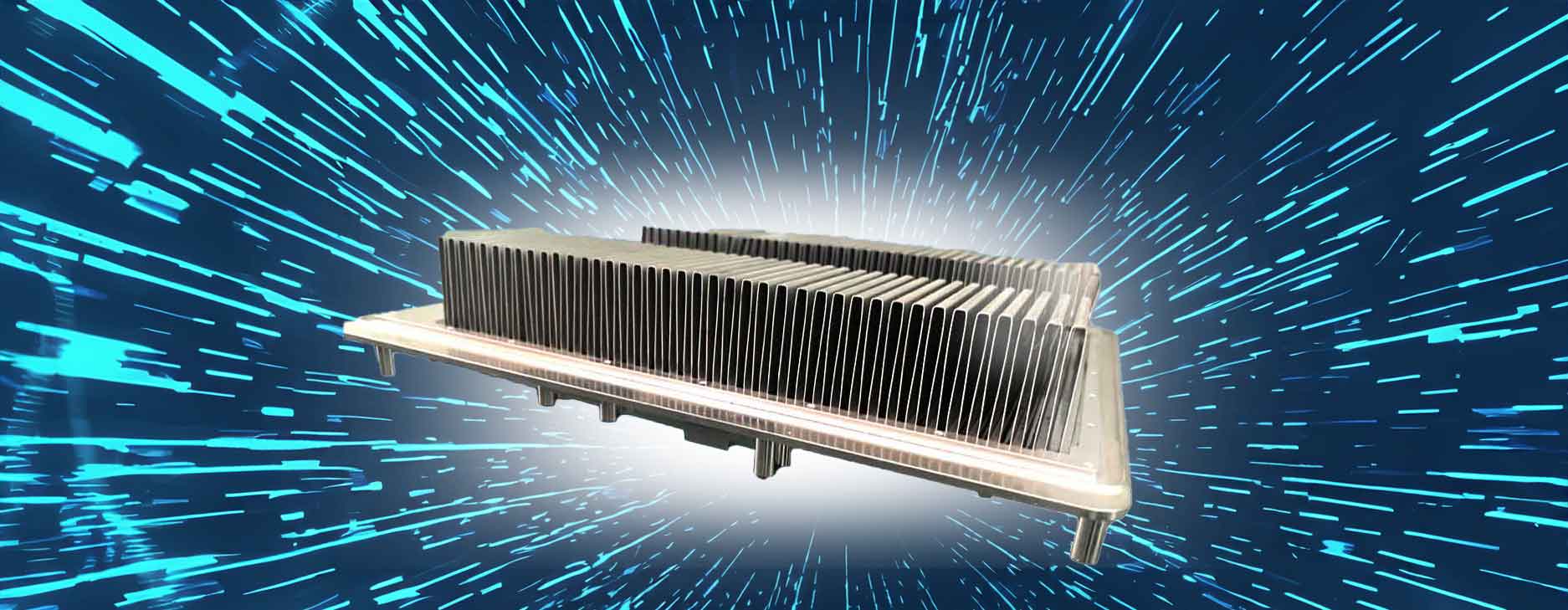
Folded Fin Heatsinks: Manufacturing Process, Advantages & Applications
What Are Folded Fin Heatsinks?
Folded fin heatsinks are lightweight, high-surface-area cooling solutions created by folding thin sheets of metal (typically aluminum or copper) into a continuous series of fins. This design provides excellent heat dissipation in compact spaces, making folded fins popular for demanding thermal applications.
Manufacturing Process
The folded fin process is efficient, scalable, and ideal for high-volume production. It typically includes:
1. Slitting & Material Preparation
Thin aluminum or copper sheets are slit into precise widths based on the required fin height and density.
2. Fin Folding
The metal strip is fed through specialized folding equipment that creates continuous fin shapes such as:
- Straight fins
- Louvered fins
- Wavy or sinusoidal fins
- Offset fins
These shapes help improve airflow and thermal performance.
3. Cutting to Length
The continuous fin strip is cut to the exact size needed for the heatsink design.
4. Assembly to Base
The folded fins are attached to a heat-spreading base using:
- Soldering / brazing
- Thermal epoxy bonding
- Friction stir welding (less common)
- Mechanical methods (crimping, staking)
5. Final Machining & Finishing
The heatsink may be machined, anodized, or surface-treated to improve thermal efficiency and corrosion resistance.
Advantages of Folded Fin Heatsinks
1. Extremely High Surface Area
Folded fins provide more surface area than extruded or stamped fins of similar size—translating to higher cooling performance.
2. Lightweight with Excellent Thermal Efficiency
Thin fins allow for:
- Lower weight
- Faster heat transfer
- Better airflow characteristics
Ideal when weight is a constraint.
3. Highly Customizable
Engineers can easily tailor:
- Fin pitch
- Fin height
- Fin shape
- Base thickness
- Material type
This allows optimization for forced air, natural convection, or sealed environments.
4. Great for High-Density Cooling
Because fins can be extremely thin (down to fractions of a millimeter), folded fin heatsinks excel in high-power, space-limited designs.
5. Versatile Assembly Methods
Folded fins can be bonded to virtually any base design:
- Copper, aluminum, or composite bases
- Vapor chambers
- Heat pipes
- Liquid cold plate covers
6. Cost-Effective for Medium to High Volumes
The folding process is efficient and repeatable, offering strong value compared to fully machined fins.
Applications of Folded Fin Heatsinks
Folded fin designs are commonly used in industries requiring high heat dissipation in compact formats, including:
Electronics & Power Systems
- Power semiconductors (IGBT, MOSFET, SiC modules)
- Telecom and 5G base stations
- High-density power supplies
Thermal Assemblies
- Vapor chamber heat sinks
- Heat pipe assemblies
- Hybrid liquid cooling systems
Aerospace & Military
- Avionics cooling
- Ruggedized electronics
- Lightweight thermal assemblies
Automotive & EV Systems
- Onboard chargers
- DC-DC converters
- Battery thermal modules
LED Lighting
- High-output LED modules
- Stadium and street lighting systems