
Quality Control in Heatsink Manufacturing
Precision. Discipline. Proven Performance.
In high-reliability thermal systems, quality control is not a checkpoint—it is a continuous, closed-loop discipline. At Cooling Source, quality assurance is embedded at every stage of heatsink manufacturing, ensuring predictable thermal performance, mechanical integrity, repeatability, and long-term reliability across mission-critical applications.
Our quality systems are designed to support defense, aerospace, medical, telecom, EV, and industrial platforms, including ITAR-controlled programs, where failure is not an option.
1. Incoming Material Inspection
Verified from the First Cut
Objective: Ensure all raw materials meet strict thermal, mechanical, and dimensional requirements before entering production.
Key Verifications
- Aluminum and copper alloy grade confirmation (e.g., 6061, 6063, C1100)
- Material certifications (chemical composition, temper, traceability)
- Thickness, flatness, and surface condition
- Heat pipe and vapor chamber leak integrity (when applicable)
Why It Matters
Thermal conductivity, structural stability, and long-term reliability begin with material integrity. Any deviation at this stage directly impacts performance and service life—especially in regulated or defense environments.
2. Manufacturing Process Control
Repeatability by Design
a. Forming & Machining Control
- Extrusion profile accuracy
- Cold forging die consistency
- CNC machining tolerances
- Fin pitch, height, thickness, and straightness control
b. Assembly & Integration
- Bonded fin pull-strength validation
- Swaged fin retention force testing
- Heat pipe insertion depth and alignment
- Brazing and solder joint quality (wetting, void inspection)
c. Surface Treatments
- Anodizing thickness and uniformity
- Black anodize emissivity verification for radiation-assisted cooling
- Post-process cleanliness validation (oil- and debris-free)
Why It Matters
Controlled processes prevent airflow restriction, thermal degradation, and mechanical instability—common failure modes in high-power and high-vibration environments.
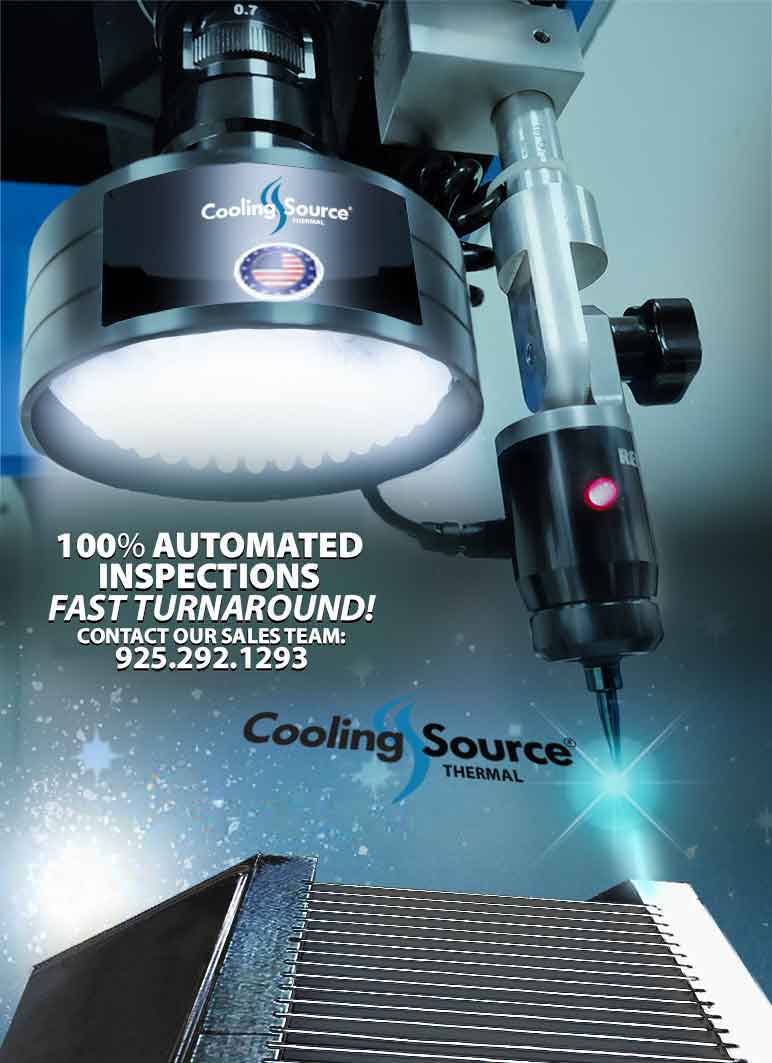
3. Dimensional & Visual Inspection
Measured, Not Assumed
Inspection Methods
- Precision calipers, height gauges, and CMM measurement
- Go / No-Go gauges for repeat production
- 100% visual inspection (or defined AQL) for:
- Bent or damaged fins
- Cracks or deformation
- Surface defects, oxidation, or contamination
Typical Control Targets
- Fin thickness: ±0.05 mm
- Base flatness: ≤0.1 mm (application-dependent)
4. Mechanical & Structural Validation
Built to Survive the Real World
Testing Includes
- Fin pull and shear strength testing
- Vibration and drop testing for ruggedized designs
- Threaded hole torque validation
- Heat pipe retention force verification
Why It Matters
Ensures heatsinks maintain mechanical and thermal integrity through handling, shipping, vibration, and long-term field operation.
5. Thermal Performance Validation
Performance Proven, Not Estimated
Thermal Test Methods
- Thermal resistance testing (°C/W)
- Controlled airflow and wind tunnel validation
- Power cycling and steady-state testing
- Benchmarking against qualified “golden” samples
Measured Parameters
- Base-to-ambient thermal resistance
- Temperature uniformity
- Heat pipe activation and transport efficiency
Why It Matters
Confirms real-world thermal performance—not just dimensional compliance—under actual operating conditions.
6. Reliability & Environmental Testing
When the Environment Is the Challenge
Performed as required for demanding applications:
- Thermal shock and cycling
- High-temperature aging
- Salt spray and corrosion resistance
- Humidity exposure testing
Commonly applied for defense, aerospace, automotive, telecom, and outdoor electronics.
7. Final Inspection & Packaging Control
Delivered as Intended
Final Quality Steps
- 100% inspection or statistically controlled sampling
- Label verification and full lot traceability
- Protective packaging to prevent fin deformation
- Moisture control for long-distance or overseas shipments
8. Documentation, Traceability & Compliance
Audit-Ready by Default
- Lot tracking and serial traceability
- Inspection records and SPC control charts
- Corrective and Preventive Action (CAPA) system
- Compliance with ISO 9001 and customer-specific quality requirements
- ITAR-compliant process control, data handling, and restricted program segregation
The Value of Disciplined Quality Control
- Consistent and repeatable thermal performance
- Reduced field failures and program risk
- Faster customer qualification and approval cycles
- Lower rework, scrap, and warranty exposure
- Trusted supplier status with Tier-1 OEMs and defense primes